Why We Need The Lost Epic
Author's Note by Vivek Dutta Mishra
Every generation retells the Mahabharata in its own tongue and temperament. Some versions are poetic, others political. Some elevate the divine; others question it. Yet, over centuries of retellings, something essential has quietly slipped away—the why behind the story. That loss, that erosion of meaning, is what gave birth to The Lost Epic series, and its first voice, The Accursed God.
The journey began not with an ambition to rewrite the grandest tale of our civilization, but with two deceptively simple questions that refused to leave me in peace.
1. The First Question: Was Bhishma Great or Greatly Delusional?
When I first encountered Bhishma, I met not a hero, but a paradox. Here was a man tutored by Vashistha and Parshurama—a sage among warriors, the conscience of a kingdom. And yet, his choices often defied reason. His vow of celibacy, taken to protect his father’s love, cascaded into a century of tragedy. His loyalty to the throne made him serve kings unworthy of his wisdom. His silence in the hall of Dryutkrida became the echo that legitimized injustice.
Was he then the greatest man of his time—or the most delusional fool? Did his oath protect the king or the kingdom? The family or the idea of Aryavarta?
If we call him delusional, we enter the domain of modern storytelling—where flawed heroes are the only kind we trust. Yet, despite his contradictions, Bhishma endures in our memory not as a failure, but as a legend. Why? What is it that makes generations bow to a man whose choices we can scarcely defend?
That question opened the door to a deeper one—a moral puzzle that lies at the heart of The Lost Epic.
2. The Second Question: Have We Reduced the Mahabharata to a Family Feud?
Modern interpretations of the Mahabharata often reduce it to a tragic inheritance dispute—a royal property case between cousins. The Kauravas and Pandavas become litigants; the battlefield, a courtroom; Krishna, a cunning strategist. If that were all, why would Krishna call it a Dharma Yudha? Why would he urge Arjuna to fight his own kin in the name of righteousness? Why did the entire Aryavarta—hundreds of kingdoms—rush into a war that would annihilate civilization itself?
Imagine for a moment that the feud between Kauravas and Pandavas had been settled peacefully. Would the world of Aryavarta have been spared from war? Hardly. Beneath that feud were dozens of simmering conflicts—Drona and Drupada, Satyaki and Bhurisrava, Bhagadatta and Krishna. Each rivalry carried its own wound, its own sense of injustice. The Great War, then, was not a sudden eruption but an inevitable culmination—the last gasp of an order crumbling under the weight of its own contradictions.
It was not merely a war for land. It was a war for Dharma itself—for the very idea of what it means to be right.
And that, I realized, is what we have lost.
3. Rediscovering the Forgotten Epic
When I began writing The Accursed God, I wasn’t searching for new mythology. I was searching for lost memory.
Our collective retellings have preserved the grandeur of the Mahabharata but not its soul. We remember the heroes, the weapons, the battles—but forget the fragile humanity beneath them. Yet at its heart, the Mahabharata is not a tale of greys or moral confusion—it is the eternal struggle between two trees: the Tree of Dharma and the Tree of Adharma. As long as both stand in the same soil, humanity must choose under which shade it will rest.
The Mahabharata’s essence lies in the conviction that Yato Dharmah Tato Jaih—where there is Dharma, there is victory—and that Dharmo Rakshati Rakshitah—Dharma protects those who protect it. The Lost Epic seeks to restore that conviction, reminding us that while truth may vary with perspective, Dharma does not.
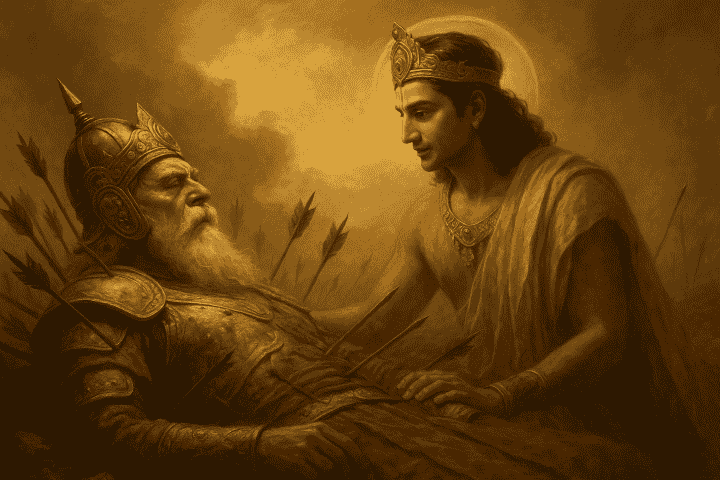
In the Prologue of The Accursed God, Krishna warns Bhishma that even their conversation will one day be distorted. “Truth is not Dharma, Pitamah. Truth is not absolute; it changes with time and context. That is why we need another word for the truth—Dharma.” Krishna’s prophecy was chilling: no matter what they say today, tomorrow’s world will misinterpret it. He insists that Bhishma’s version must survive, so that at least one voice of the age might echo uncorrupted. That warning—the inevitability of distortion—is the very reason this retelling matters.
Krishna’s insistence in that moment defines the purpose of The Lost Epic. His warning is not about despair—it is about duty. If truth changes, then every age must rediscover Dharma anew. That is why this story must be told again and again.
4. The Awakening of Dharma
The Mahabharata was never about moral ambiguity—it was about moral awakening. Those moments of awakening are what turn a Ratnakar into Valmiki, a Siddhartha into Buddha, a Jesus into Christ, and a Mohandas into Mahatma. Yet each transformation begins with a moment of realization—the stillness before a decision that redefines destiny.
For Arjuna, that moment came when he laid down his weapon on the battlefield, believing the war to be meaningless. In that stillness, he glimpsed the futility of revenge, pride, and ambition. And then Krishna spoke—revealing to him that it was not a property dispute, not a matter of vengeance. The moment Arjuna laid down the weapon, the Dharma Yudha began. That instant of surrender was the birth of clarity—the understanding that Dharma transcends logic, blood, and promise. It was that same realization that made Krishna break his own oath and raise a weapon—to uphold Dharma beyond the bonds of his own word.
When stories lose that clarity, civilizations lose their direction. When we turn Bhishma into an idol rather than a question, or Krishna into a symbol rather than a guide, we forget that Dharma is not mere rule-following—it is the living spirit of righteousness that sustains all order.
The Lost Epic is not an act of rebellion against tradition but a reclamation of its purest truth. It seeks to bring us back to that unwavering light—to the idea that Dharma, once understood, never confuses; it illuminates.
5. The Humanization of the Divine
Another reason we need The Lost Epic is to reclaim the humanity buried beneath divinity. Over time, our myths have been airbrushed into perfection. Gods became flawless; humans became pawns. But what if the gods themselves were conflicted? What if Krishna—the divine strategist—was haunted by foresight and sorrow? What if Bhishma’s strength was also his curse?
In The Accursed God, I explore Krishna not as a god manipulating destiny, but as a being burdened by foresight—the only one who knows that even victory will taste like ash. His title, The Accursed God, is not blasphemy. It is empathy. For even gods, when entangled in human affairs, inherit human pain.
By humanizing the divine, we rediscover ourselves. We understand that righteousness is not granted from above; it is forged in the struggle within.
6. The Missing Context of Aryavarta
The Mahabharata as popularly told begins and ends with the Kuru family. But the world it depicts—the Aryavarta—was a vast civilization, teeming with kingdoms, alliances, and rivalries. To reduce it to a single dynasty is to shrink a continent into a courtroom.
In The Lost Epic, I seek to restore the geopolitical and cultural context of that era. Why did Panchal, Magadh, and Gandhara matter? Why did so many nations join a war that wasn’t theirs? What ancient codes and scientific wisdom shaped their choices? Each of these questions opens a window into the forgotten complexity of our ancient world—a world driven not only by faith but by politics, science, and moral duty.
Reclaiming that context is not just an act of historical imagination. It is a way of reconnecting with our civilizational DNA—understanding that our ancestors were not mere mythic caricatures, but thinkers, rulers, scientists, and moral philosophers navigating their age of uncertainty.
7. The Moral Architecture of War
Every civilization must eventually face its own Kurukshetra—a point where its ideals collide with its interests. The Mahabharata was not written to glorify war, but to warn us about its inevitability when Dharma is ignored.
Bhishma, Drona, Karna—each fought believing they were right. Krishna too believed he was right. That is the test of Dharma—its demand that we discern the right, not merely claim it. When morality becomes ego and righteousness becomes weapon, even gods bleed.
In the age of information wars and polarized truths, the Mahabharata feels eerily contemporary. We too live in a world drowning in facts but starving for Dharma. We too confuse victory with justice.
That is why we need The Lost Epic—to remind us that being right is not the same as being righteous.
8. Bhishma and the Mirror of Modernity
Bhishma is not a relic; he is a mirror. Every institution that values loyalty over conscience, every individual torn between duty and morality, carries a fragment of Bhishma’s curse. His story endures because it is our story—of good intentions gone astray, of promises kept too long, of silence mistaken for virtue.
When Krishna tells Bhishma that truth changes but Dharma endures, he is not speaking to the past. He is speaking to us—to a generation that has forgotten to ask why even as it drowns in how.
The Lost Epic does not seek to judge Bhishma. It seeks to understand him. Because only by understanding our ancestors’ dilemmas can we hope to navigate our own.
9. The Journey Ahead
The Accursed God is only the beginning. It is the first voice in a symphony of lost stories—each reexamining a legend through the lens of eternal Dharma.
The Lost Epic is not about demystifying mythology. It is about restoring its relevance—about turning the gaze inward.
If it succeeds, even a little, it will not be because it told a grand story, but because it made readers pause and ask: What does it mean to be right?
That, to me, is the oldest and most necessary question in the world.
And that is why we need The Lost Epic—because in forgetting it, we have forgotten how to ask, and how to stand beneath the right tree.