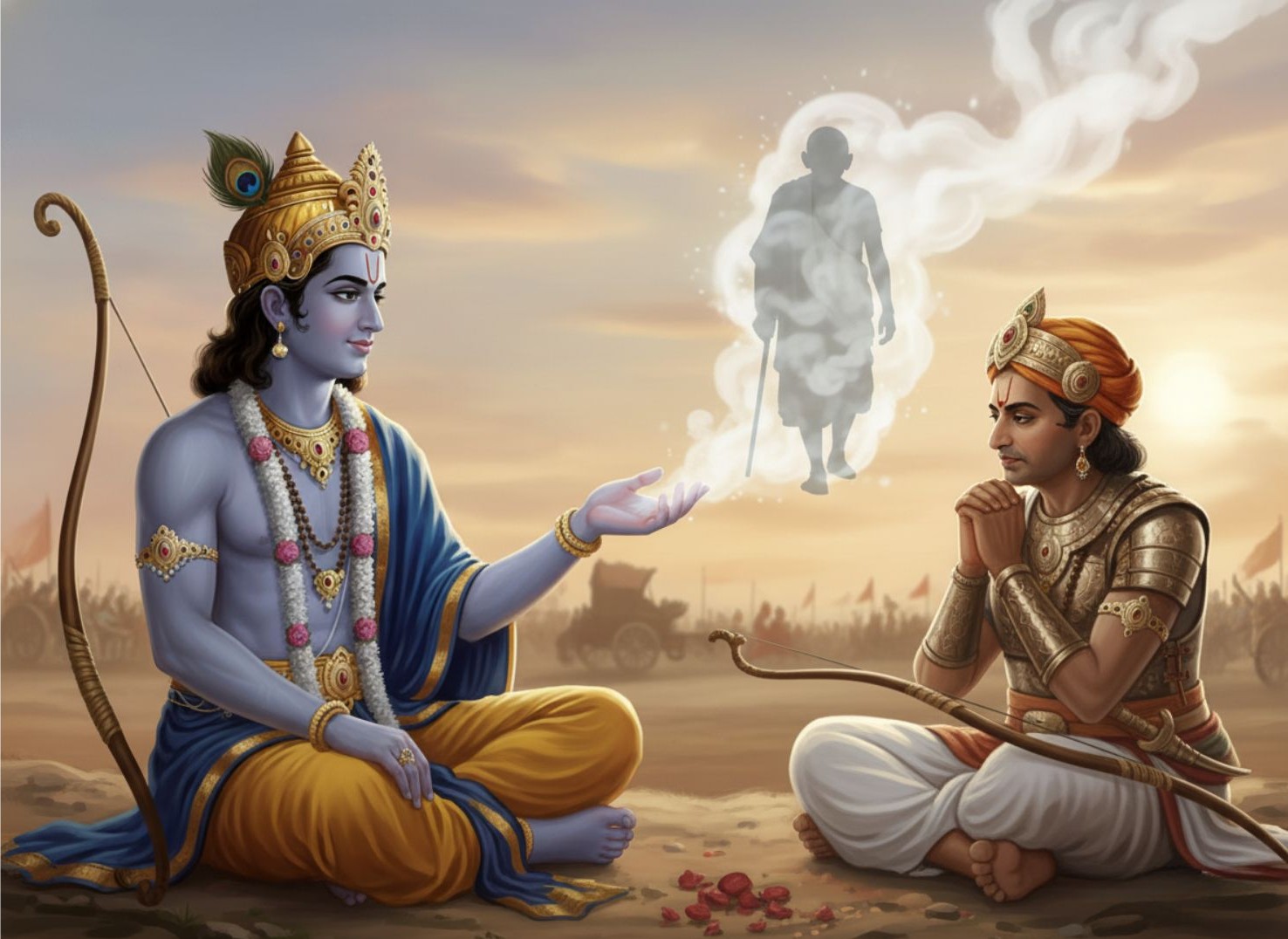
The Day Krishna Spoke Back
“You are already giving me a voice,” a whisper said in my mind one night. “Then why not let me speak what I would have said?”
That was how the scene from Chapter 17 – Ranchod was born.
I had been wrestling with it for months — the moment when Krishna turns away from battle, refusing to fight a war he could easily win. Every draft I wrote either sounded apologetic or moralizing. I didn’t want Krishna to sound like a pacifist philosopher; I wanted him to sound like... like Krishna — the strategist who sees through time itself, who knows the cost of every choice.
And yet, as I stared at that empty page, a question kept troubling me: Would Krishna ever defend non-violence? Could the charioteer of Arjuna, who urged action on the battlefield, also be the same person who can inspire non-violence?
That night, while revisiting The Lost Epic drafts, something stirred. I imagined Krishna watching the future — watching men, in his name, justify every cruelty as “righteous duty.” I could almost hear him sigh. And then came that inner voice:
“I refuse to set a precedent where men, in my name, grow so impatient that they see violence as the easiest solution to all their problems.”
I wrote the line down, hands trembling slightly. It didn’t feel like invention. It felt… given.
“The age of Kali will push men toward that impulse.”
That sentence haunted me. Because I knew what it meant — that in our time, the Gita is being read as a doctrine of war, not wisdom. That the same scripture that once urged understanding has become a slogan for intolerance. I wasn’t trying to reinterpret Krishna; I was trying to rescue it from misinterpretation... rescue it from being the fake and misinterpreted voice of Krishna.
in our time, the Gita is being read as a doctrine of war, not wisdom. That the same scripture that once urged understanding has become a slogan for intolerance.
The decision to let him speak of a future man who walks with a stick came later, almost naturally. I wanted a counterpart to Ranchod — a reflection of how far the idea might travel through time. When Krishna tells Arjuna, “Empires will crumble… before a lone man who walks with a stick, speaks through silence, and defies with compassion,” I wasn’t thinking of any one person, yet I couldn’t deny the resonance.
I remember pausing after writing that paragraph. There was a kind of stillness in the room, like I’d trespassed into something sacred. Somewhere in that silence, I heard Krishna again — half amused, half approving:
“So you have found me in him, have you not? Ever wondered why I incarnated as Buddha?"
That was my moment of reconciliation. Enlightenment! If Vishnu’s ninth incarnation was the Buddha — the one who renounced violence and taught compassion — then surely the philosophy of Ranchod was its seed. Krishna’s vision of the future, in The Shadows of Kali, was never a prophecy of politics. It was the recognition that Dharma must evolve. That there will come a time when the truest warrior will fight not with arrows but with conscience.
Writing that line for Krishna felt like closing a circle. The Mahabharata has always been less about gods than about choices — about how the same truth must be rediscovered in every age. I realized that my story wasn’t trying to modernize the epic; it was trying to listen to it.
“Myth is simply truth waiting for its time.”
In every age, we make Krishna speak again. We make him ours. Sometimes we make him a warrior, sometimes wise, sometimes political. But the real Krishna — the one who transcends scripture — is not the God of victory, but of understanding. He appears whenever humanity stands at the edge of its own anger and whispers, “Not that way.”
I faced my own dilemmas while writing him. How do you make a god, human without diminishing him? How do you make him prophetic without turning him into a moral lecture? Every time I hesitated, that same inner voice returned — the same one that opened this essay:
“You are anyway giving me a voice… then why not pen my voice?”
And so I did. I let him speak of the future, of compassion, of the peril of men growing impatient with peace. I let him foresee a man who would change the world not by striking, but by refusing to strike.
The Quiet Conviction
I know some readers will read that passage and see a reflection of a man from our recent past. Others will see it as allegory. Both are right. Because when Krishna speaks of that future man, he isn’t predicting — he’s remembering. The time, after all, moves in circles, not lines. Its end is its beginning. The Buddha is born from Krishna’s exhaustion with war; compassion rises from the ruins of Dharma.
“Arjuna and Bhimasena will become mythical in that future,” Krishna says. “And so will that man.”
I believe that’s true. I believe Krishna did whisper that sentiment once — perhaps not to Arjuna, but to time itself. Perhaps to the quiet corners of human conscience that still dare to listen. And perhaps he whispered it again to me, across a century and a dream, urging me to give him back that voice — not the one shouting over chariots, but the one that murmurs above the din: “Let men not mistake my Gita for a sword.”
“What we cannot emulate, our ego either seeks to destroy — or condemns.”
That line, near the end of Samrajya, remains my personal confession. I wrote it for Krishna, but it could as easily have been for all of us. We live in a world where moral restraint is mistaken for weakness, where silence is dismissed as apathy, and where compassion often seems irrelevant. Yet I believe the world still hungers for examples of Ranchod — those who dare to turn away from destruction even when the crowd demands a fight.
When I finished writing those two chapters, I realized something had changed in me too. I no longer saw the Mahabharata as a closed story of gods and kings. I saw it as a living continuum, one that stretches from the battlefield of Kurukshetra to every street and conscience that must choose between violence and understanding.
If The Shadows of Kali carries any prayer, it is this — that we do not let Krishna’s words be used to justify what he once warned against. That we remember his truest lesson: that power without compassion is not Dharma; it is Kali’s shadow.
And maybe, somewhere in the endless dialogue between heaven and earth, Krishna smiles again — amused, forgiving, timeless — and says, “At least someone remembered what I meant.”
Pull Quotes
“You are anyway giving me a voice… then why not pen my voice?”
“Let men not mistake my Gita for a sword.”
“If Vishnu’s eighth was Buddha, then compassion was always the next verse of the Gita.”