Mythifying the epic is destroying the very civilization it once built.
The Lost Meaning of the Epic
The words Itihasa and Purana once meant history and memory—not myth.
Once upon a time, the Ramayana and Mahabharata were not fantasies of gods but chronicles of a civilization that believed moral law was as real as gravity. They were blueprints of governance, psychology, and ethics—the cultural documentation of an age that sought order in the universe and within the self.
In modern parlance, myth has come to mean fiction. The word itself has become an eraser. When we call the epics mythology, we unknowingly relegate them to the shelf of legends and fairy tales. What was once a mirror of civilization now stands dismissed as superstition.
When the Gods Are Put on Trial
Interpretation is not the enemy—indifference is.
In the last few decades, our retellings have grown louder but lighter. Heroes are reduced to caricatures; villains are rehabilitated as misunderstood geniuses. The stories of Satyameva Jayate—“Truth alone triumphs”—and Yato Dharmastato Jayaḥ—“Where there is righteousness, there is victory”—have been repainted in fashionable gray.
In this blur, the very distinction between heroism and wickedness vanishes. Bhishma becomes delusional; Krishna manipulative; Rama insecure; Yudhishthira hypocritical. The moral compass that once guided generations spins aimlessly.
The Tradition of Renewal
You cannot wear pure gold; you must shape it to hold the diamond.
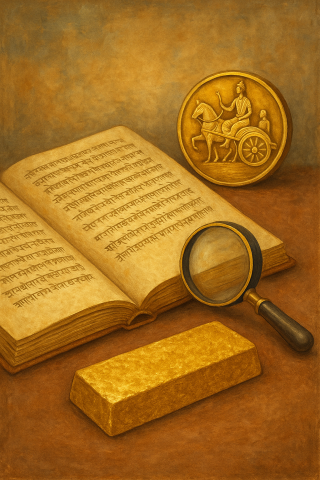
Renewal was always allowed—even encouraged. In the Shruti–Smriti tradition, every age could restate eternal truths in its own tongue. But freedom came with discipline. The ancients knew that pure gold—absolute truth—cannot be worn as it is. To create something beautiful and wearable, one must reduce its purity.
Adding new narratives to the authentic core is like turning 24-carat gold into 18-carat—to hold the diamonds of creativity while retaining the essence. For example, Lakshman Rekha does not appear in Valmiki’s Ramayana (24-carat) but in Ramcharit Manas (18-carat)—a refinement that enhances without corruption.
The Metaphor of the 24-Carat Gold
Creative alloy enriches; false polish deceives.
The 24-carat gold represents the pure essence of our epics. The 18-carat gold is the artistic retelling that carries this truth beautifully into the world. But imitation gold—random distortions posing as truth—destroys the epic’s dignity.
Distortions such as “Draupadi insulted Karna, so her humiliation was justified” are not creative liberties—they are moral corruptions. They do not add a diamond; they destroy the gold itself.
Why This Debate Matters
The world today suffers not from lack of information, but from lack of conviction.
Civilizations evolve through continuity, not rupture. When every generation rebuilds from scratch, nothing endures. The moral vocabulary of a society is built by repetition. When we hear Satyameva Jayate for a thousand years, it becomes instinct. When we mock it for a generation, that instinct fades.
Preserving the Core, Polishing the Surface
Let Krishna’s strategy be debated, but let his purpose remain luminous.
We may question, retranslate, dramatize, and even fictionalize—but we must never invert the moral compass. Let Bhishma’s conflict be humanized, not mocked. Let Draupadi’s fury be explored, not sensationalized.
Retelling is worthwhile only when it reminds us why the story mattered in the first place.
The Responsibility of the Modern Reader
History preserves events; epics preserve values.
Readers must approach the epics not as consumers of nostalgia but as inheritors of meaning. The question is not whether Rama or Krishna walked the earth, but whether we still walk the path they revealed.
Closing Reflection
A civilization that calls its history myth writes its own obituary.
The Lost Epic project begins with restoration, not reinvention. The 24-carat gold still exists—buried under alloy. Our task is to melt away distortion and bring back the shine—not for worship, but for guidance.
Let the diamonds of creativity keep sparkling—but let the gold remain untarnished.
Source: Prologue — The Accursed God, ch_prologue_001.